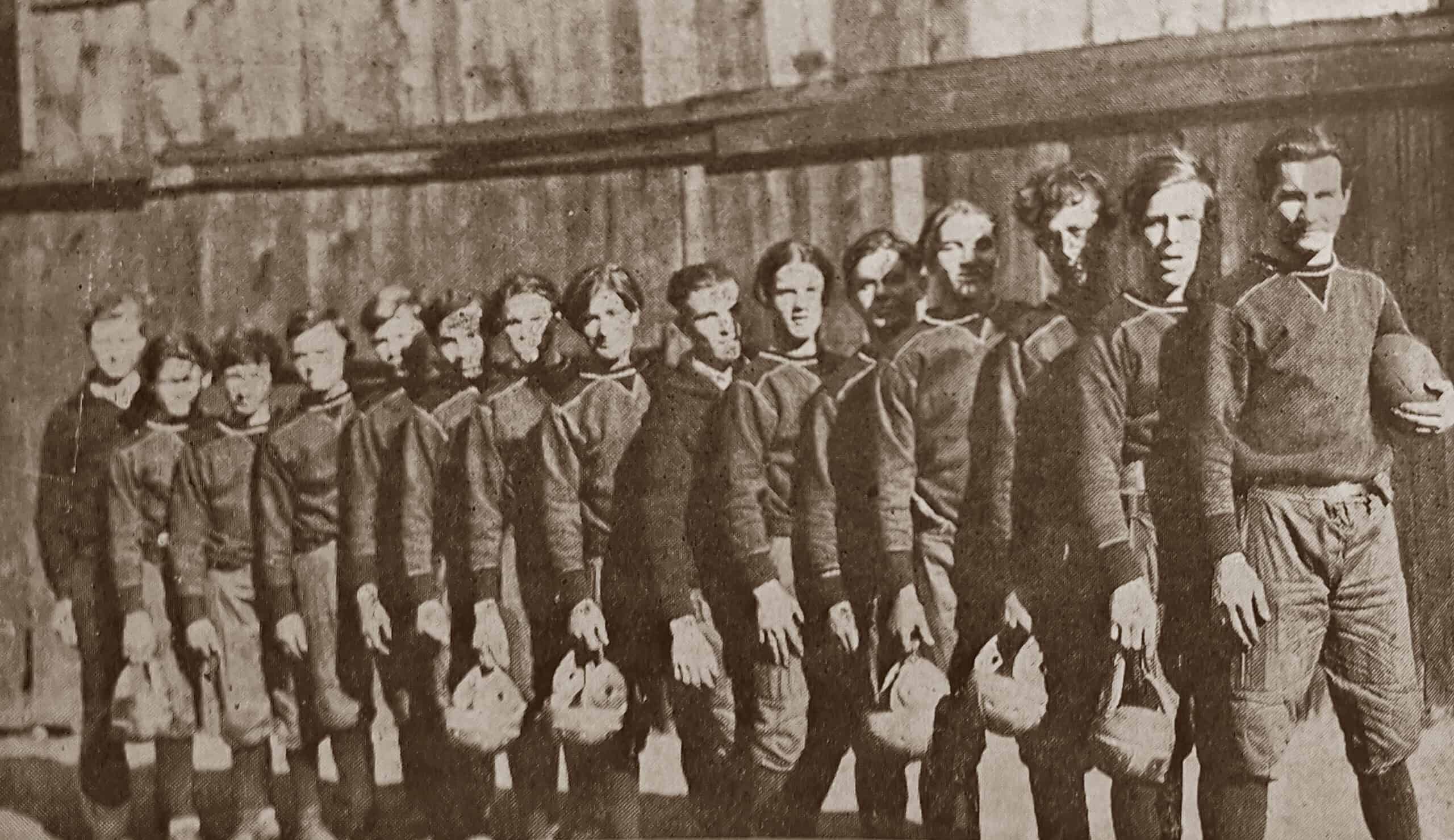
Their games may not have generated the spectacle and fandom of Super Bowl Sunday. But 100 years ago, Mercy Home’s brand new and scrappy football team, known as the Mission Flashes, gave our young people something to root for.
The decade of the 1920’s was known as America’s Golden Age of Sports. Radio and newsreels helped feed a post-World War I population’s appetite for new heroes. Names like Babe Ruth, Jack Dempsey, and Knute Rockne became familiar ones in households everywhere and were worshiped by throngs of fans that packed massive newly built arenas.
Two of the newly formed National Football League’s charter members played in the city—the Chicago Bears, who moved from Decatur, Illinois in 1921 to thrill crowds at Wrigley Field every Sunday, and the Chicago Cardinals, who would share their home with the White Sox at Comiskey Park until their departure for St. Louis in 1960.
It was into this era of big-time sports that in 1926 we introduced the “Mission Flashes” football team.
Like all the young men they represented back at the “Working Boys Home,” as Mercy Home was then known, the Flashes were underdogs from the day they were born. Taking the field in black and orange uniforms, the team struggled in its inaugural campaign against area teams, winning only one of five games played that year.
“As football experts know, it takes time to build up a winning team,” explained the squad’s coach, Dr. Francis Dwyer. “The present season has been devoted more to teaching the fundamentals rather than trying to win games.”
But with hard work, patient coaching, and a commitment to mastering the fundamentals of the game, their fortunes soon improved. In the 1930s, with America in the grips of the Great Depression, the Flashes kept hopes up at home by earning perfect records during their 1930 and 1935 seasons. The Mission team often dominated local opponents that included athletic clubs and Catholic high schools like Mt. Carmel, St. Rita, St. Patrick, DeLaSalle, and their biggest rival Loyola Academy.
Later, many mission boys would play for their own schools. In 1938, for example, six of the Home’s best players would become stand outs at nearby “Old St. Pat’s.” Naturally, the Mission team was less competitive as a result, but our leadership kept sight of the big picture—the benefits of physical activity and team sports to our young people. “While we did not win many games we did get a lot of exercise,” noted the January 1938 issue of the Home’s donor magazine, The Waifs Messenger, concluding that the accomplishment was “consoling to the coach.”
While the first quarter of the 20th century at Mercy Home was marked by the expansion of new trade and occupational education programs, the next several decades saw an increased emphasis on organized sports as a way to build mind, body, and a foundation for success. In 1927, the Home also launched a basketball program with two age divisions, and a baseball team.
The Home’s leadership and its young people became central to the athletic programs of the Catholic Youth Organization, founded in Chicago in 1930. Its boxing program was the stuff of legends.
In more recent decades, our young people competed in a weekly intramural basketball tournament that also promoted academic excellence, while the Home also fielded inter-agency teams in basketball and volleyball.
Close ×
Want more news like this?
Sign up for our email list and stay up to date with Mercy Home!
Comments