When a young adult is in crisis and reaches out to Mercy Home for help, every minute matters.
Urgency is the impetus behind Daley Home, a new living program that opened at Mercy Home for Boys & Girls in August 2026. Designed specifically for young men ages 18 to 21, Daley Home responds to a growing need, providing expedited stability while helping residents build the skills, support systems, and confidence needed to successfully transition into adulthood.
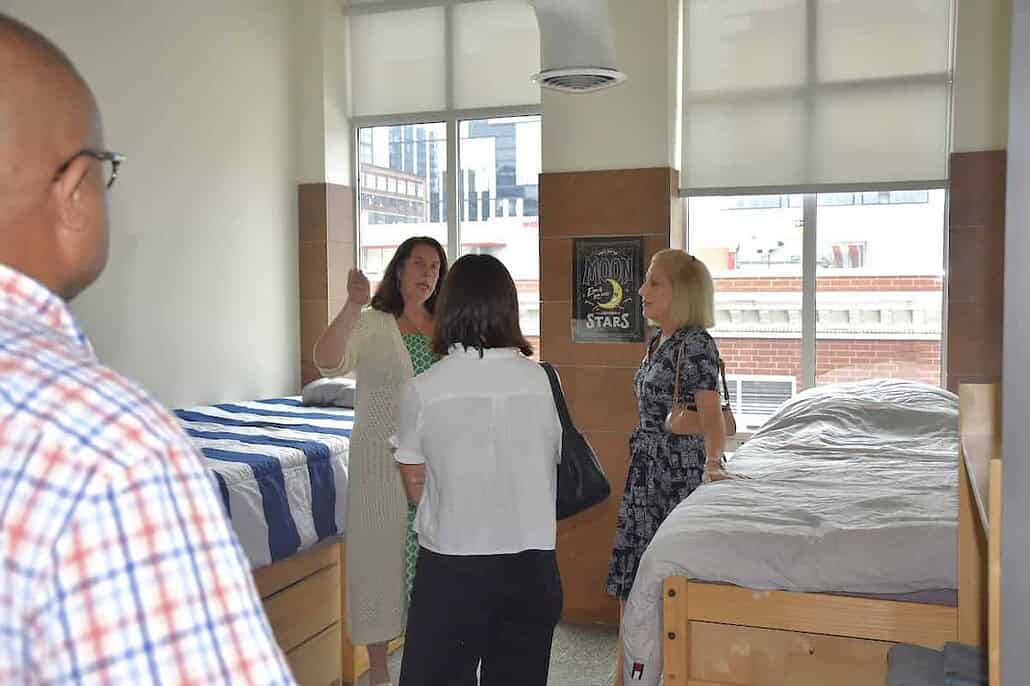
Daley Home occupies the physical space that formerly housed a living program of the same name that was ultimately shuttered during the COVID-19 pandemic. The dormitory-style wing has been refurbished to welcome 10 new residents. But what distinguishes the new Daley Home from its predecessor, and from other living spaces within Mercy Home, are its admissions and care structures.
Unlike Mercy Home’s other residential programs, Daley Home will serve as both an entry point and a place of assessment and intentional observation. The new program is designed to condense the period between when a young person contacts us and when they are able to move in. At the same time, it gives Mercy Home’s clinical team the opportunity to better understand each resident’s individual needs before determining the best path forward.
Daley Home addresses the gap that many young adults face between the moment they reach out for help and when the Home has enough information to determine the best path forward. Typically, Mercy Home’s admissions process for young people involves extensive interviews, assessments, educational testing, and coordination with parents or guardians before a young person moves in.
While those steps in our admissions process remain critical to determining the most tailored and effective care plan for most of the Home’s residents, Daley Home offers a different approach for legal adults by allowing them to move directly into a safe and supportive environment much sooner.
Because Daley Home residents will be of age, (18-21 years old) they can consent to Mercy Home’s services on their own without involvement by a guardian, allowing us to streamline the admissions process while still providing comprehensive care right away.
Daley Home creates space for new residents to stabilize while staff assess their needs. Upon arrival, each new resident will enter a 30-day “intentional observation phase.” During that time, they will eat meals together, participate in activities together, and establish routines within the home while staff observe how they adjust to the structure and identify the services they may need.
“We’re trying to get people from the point of contact, calling us because they need assistance, and into a bed and receiving quality care quicker,” Vice President of Residential Programs Alicia Osborne said. “Then we’re taking those first 30 days to identify individual needs and service recommendations, complete assessments and testing that allow us to best serve the young person, setting them up for success from the beginning and getting them ready to be without us from day one.”
The observation period also allows staff to identify mental health concerns, substance use, medical needs, or other challenges that may not be apparent during an initial interview.
“If they need medications, medication changes, psychiatric evaluations, or substance use treatment, we’re making certain those things are handled as soon as possible so that all essential services are being met,” Osborne said.
This approach allows young adults experiencing housing instability or other crises to receive the support they need now before they are ready to integrate fully into one of Mercy Home’s longer-term residential communities.
“What makes Daley Home special is we’ve heard and listened to a lot of program staff saying that the self-report [in admissions] is not always the best guide to what we’re going to see in a youth,” said Director of Young Adult Programs Joi Basley.
She compares the traditional admissions process to a job interview.
“A lot of kids want to get into Mercy Home,” Basley said. “You’re going to say what you think we want to hear. But it may not happen until they get here that we realize this person isn’t a good fit for Mercy Home.”
Rather than placing young people immediately into one of Mercy Home’s established living programs, Daley Home gives both residents and staff time to determine the best next step.
“We’ll take on that honeymoon period,” Basley said. “We’ll be able to work and provide treatment before introducing them into an already stabilized and established milieu.”
In a sense, Daley Home will be both a landing place and a launching pad.
Life inside Daley Home will mirror the structure and expectations found throughout Mercy Home. Residents will follow regular wake-up times, meals, chores, hygiene routines, and therapeutic programming. But it will also offer enhanced assessment and clinical support. Residents will participate in individual and group therapy, one-on-one meetings with transition coaches, emotional regulation and coping skills groups, and substance use counseling led in part by a nationally recognized recovery specialist. A post-secondary options coordinator from our education and career team will also aid residents in pursuing employment, education, vocational training, or other next steps.
Some young men may remain at Daley Home for only a month before transitioning into another Mercy Home program. Others may stay several months as they continue working toward stability. Some may simply need temporary housing while securing employment or permanent housing and may ultimately transition to another community resource rather than another Mercy Home program.
“The goal is to use it as this transitional space to get people prepared and ready for what is to come next,” said Osborne.
When residents are ready, Mercy Home staff will work collaboratively to determine which of the organization’s young adult homes is the best fit based on observations made throughout their stay.
“There will be lots of communication between the two homes,” Basley said. “We want to set the youth, as well as the receiving program, up for success.”
Daley Home also represents an investment in Mercy Home’s clinical capacity. The home’s supervisor, program manager, and therapist will all be licensed, master’s-level clinicians, bringing additional expertise to both the new program and the organization as a whole. Their role is to carefully assess each young person’s needs during the observation period and recommend the most appropriate next step.
“My hope is that this team is able to help people not feel stigmatized,” Osborne said. “We have the resources to handle complex mental health needs, substance use issues, and other challenges while connecting young people with the services they need.”
Ultimately, both Osborne and Basley see Daley Home as more than a new residence. They see it as an opportunity to better serve young adults during one of the most vulnerable periods of their lives.
In short, the new home will accomplish two goals at once: help young men access services sooner and enhance our ability to make decisions about how best to support them. By reducing barriers to entry, increasing clinical assessment, and creating a dedicated space for stabilization and transition, the program aims to reduce crises, increase successful placements, and give more young adults a genuine opportunity to succeed long term.
“We want to start preparing them for [life] outside of Mercy Home from day one,” Osborne said. “We want them to be able to support and regulate themselves once they leave Mercy Home and be able to handle whatever life’s challenges are.”
For Basley, success will be measured in something even simpler: meeting young people where they are now and handing them the tools to build a more stable future.
“I’m looking forward to getting some youth, providing them with the treatment they need, and getting them stable,” she said. “I want to give these new youth a fresh start to being successful.”
Author: Christa Rooks During this past season’s Summer Career Institute, our Education and Career Resources Department hosted three networking lunches...


Comments